
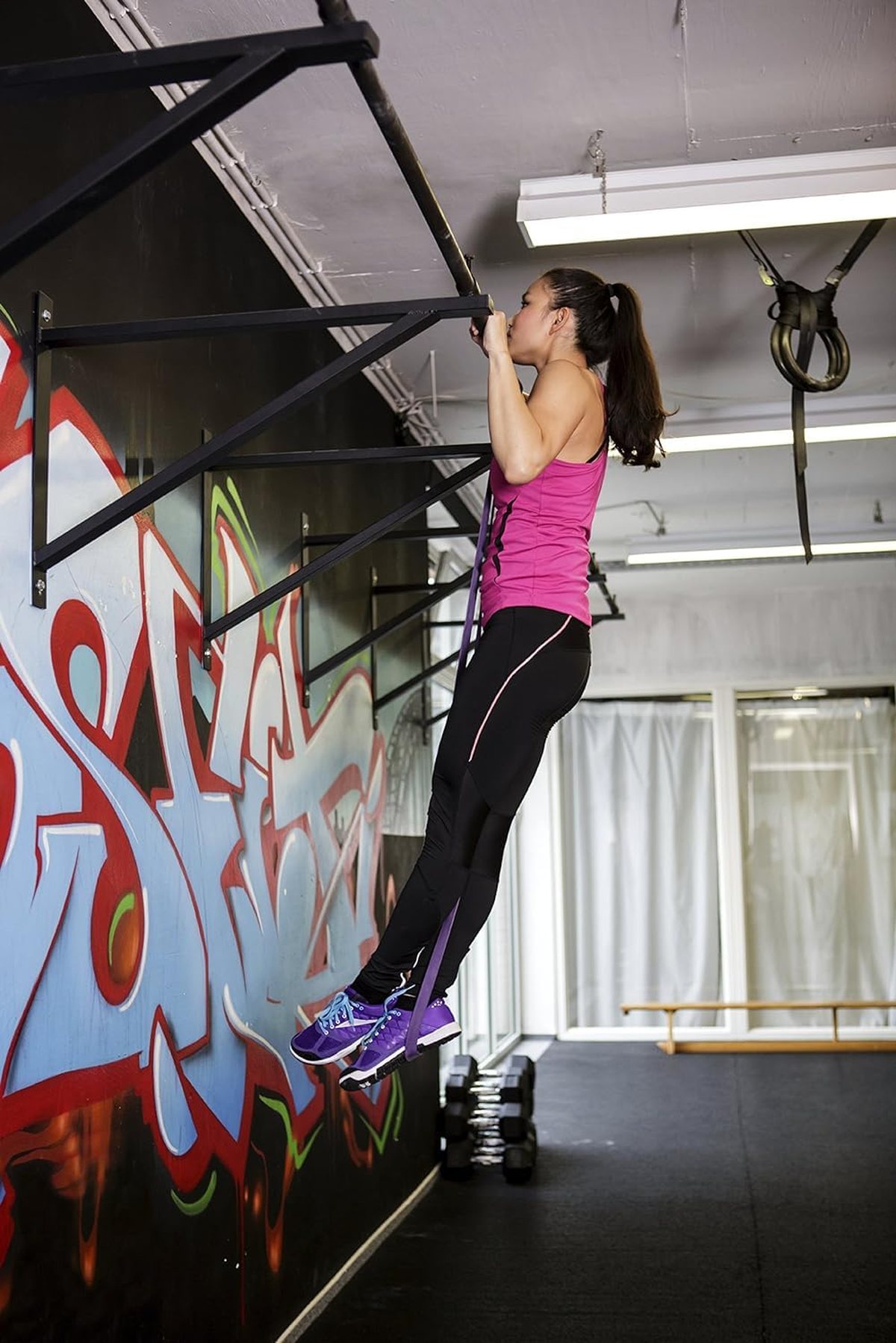
How to Do Your First Pull-Up
The pull-up is the most satisfying bodyweight exercise there is — and for most people, the most frustrating. You jump up to the bar, pull with everything you've got, and… nothing moves. Here's the good news: your first pull-up is a strength you build, not a talent you're born with. And there's a faster, smarter path than dangling and hoping.
Why your first pull-up feels impossible (and why it isn't)
A pull-up asks you to lift your entire bodyweight with your back and arms through a full range of motion. If you weigh 150 lbs, that's a 150-lb lift — heavier than most beginners ever train. There's no "lighter weight" to start with the way there is on every other exercise.
That's exactly the problem resistance bands solve. A band loops over the bar and under your feet or knees, and it gives part of that weight back to you at the bottom of the rep — right where you're weakest. Suddenly you're not lifting 150 lbs. You're lifting 150 minus the band's assistance. You get to train the real movement, today, instead of waiting months to be "strong enough to start."
The fastest way to your first pull-up: assisted training
The principle is simple and it's how nearly everyone who can do pull-ups got their first one: start with enough help to do clean reps, then remove the help a little at a time. Heavy band → lighter band → no band. Each step is a small, achievable jump instead of one impossible leap.
Want this mapped to your exact level?
Answer 4 quick questions and get a free, personalized pull-up plan — the right starting band and a week-by-week progression built for you. Takes 60 seconds.
Get My Free Pull-Up Plan →Step 1: Choose your resistance band
Pick the band that lets you do 6–10 controlled reps with full range of motion. It should feel hard — but doable with good form. If you can crank out 15 easy reps, the band's too strong. If you can't get past 3, go heavier.
| Band | Assistance | Best for |
|---|---|---|
| Blue | 65–100 lbs | Brand new — building the base |
| Green | 50–65 lbs | A few assisted reps in you |
| Purple | 35–50 lbs | Solid reps, ready to progress |
| Black | 30–50 lbs | Close to unassisted |
| Red | 10–35 lbs | The final step before rep #1 |
Tip: If a single band is still too hard, stack two together for more lift, then drop one as you get stronger. This is why a full band set beats buying one band — you never get stuck waiting on the next size mid-progress.
Step 2: Nail the movement
Form first. A clean assisted rep beats five sloppy ones every time.
- Start from a dead hang — arms fully straight, shoulders engaged (think "pull your shoulder blades down and back").
- Pull until your chin clears the bar. Not your nose. Not "close enough." Chin over the bar.
- Lower with control — take 2–3 seconds on the way down. The lowering phase builds the strength that gets you off the band.
- Full range, every rep. Back to a dead hang at the bottom before the next one.
Step 3: Your weekly workout
You don't need to live at the gym. Three focused sessions a week is the sweet spot for building pulling strength while giving your muscles time to recover and grow.
- 4 sets of 6–10 reps
- 3-second negative (slow lower) on every rep
- 90 seconds rest between sets
- 3× per week, with at least a day between sessions
Step 4: Reduce the assistance
Here's the rule that drives everything: when you can do 3 sets of 10 clean reps on your current band, drop to the next lighter one. The reps will feel hard again — that's the signal you're getting stronger. Rebuild to 3×10, then drop again. Keep climbing down the ladder until the lightest band feels easy. That's when the magic happens.
The secret weapon: negative pull-ups
If you want to speed things up, add negatives. Jump or step up so your chin starts above the bar, then lower yourself as slowly as you possibly can — aim for 5 seconds or more. Your muscles are far stronger lowering a weight than lifting it, so negatives let you overload the exact strength you need. Add 3–5 negatives at the end of a session and watch how fast the bar starts to feel lighter.
How long until your first pull-up?
For most beginners training consistently 3× a week with bands and negatives, the first unassisted pull-up comes in 6 to 12 weeks. Lighter, fitter athletes often get there faster; if you're carrying more bodyweight or starting from zero pulling strength, it may take a bit longer — and that's completely normal. The people who get there aren't the strongest. They're the most consistent.
Common mistakes to avoid
- Half reps. Stopping short of the bar or not fully extending at the bottom builds half the strength. Full range or it doesn't count.
- Rushing the step-down. If your form breaks on the lighter band, you moved too soon. Go back a band — there's no prize for skipping steps.
- Training every day. Strength is built during recovery. Three quality sessions beat seven exhausted ones.
- Quitting at week 3. This is where most people stop, right before it clicks. Don't be most people.
Your next step
You now know the method: pick a band, train the full movement 3× a week, slow your negatives, and step down the ladder as you get stronger. The only thing left is to start — with the right band for your level.
Get your free plan + the right bands
Take the 60-second quiz for your personalized progression, then grab the band set that carries you from your first assisted rep all the way to unassisted.
Get My Free Plan → Shop the 4-Band Set